A quoted price for a pneumatic paneer press can exclude the moulds, compressor, GST, freight and commissioning, making two apparently similar offers impossible to compare. By the end, you will know which specifications to request, how to estimate delivered cost, and how to test an Ambala supplier’s machine before purchase.
Key takeaways
- Separate machine, compressor, tooling, controls and delivery costs.
- Check mould size, pressing force, batch capacity and air consumption.
- Use filtered compressed air and sanitise food-contact surfaces after every batch.
- Compare supplier support, testing, spares and installation—not price alone.
What does a pneumatic paneer press price include?
A pneumatic paneer press price is comparable only after you separate the press, air system, tooling and delivery costs. A machine-only offer may contain just the stainless-steel frame and cylinder; a compressor-inclusive package may add moulds, trolley, FRL unit, solenoid valves, control panel, receiver tank and electrical controls.
| Option | Usually included | Cost you still need to check |
|---|---|---|
| Machine-only | Frame, cylinder and pressing plate | Moulds, FRL, valves, timer, compressor, air lines, controls, freight and installation |
| Compressor-inclusive | Press plus compressor and receiver | Compressor horsepower, receiver capacity, air consumption, voltage, commissioning and warranty |
| Installed package | Equipment, delivery, setup and operator training | GST treatment, unloading, site air-line work, spare seals and future tooling |
Ask for an itemised quotation showing mould count and dimensions, cylinder bore and stroke, pressure gauge or transducer, dwell timer, drainage arrangement and stainless-steel grade. “6–8 bar operation” describes the air supply, not the force applied to the paneer.
For budgeting, small commercial presses sit in the low-lakh range, while multi-mould automated systems with controls and compressor packages can reach several lakh rupees. Treat that as a planning guide, not a firm offer.
Calculate the real delivered price by adding GST, freight to your site, unloading, installation, commissioning, training, spare seals and the cost of an air line. Also ask who pays when the compressor fails and how quickly warranty service reaches you.
Which specifications determine capacity and pressing performance?
Judge a commercial paneer press machine by kilograms of curd per batch, mould count and dimensions, pressing time, and actual reload-to-reload throughput—not by “6–8 bar pneumatic operation” alone. A stated air pressure describes the supply, not the force reaching the follower plate.
| Specification | What to request | Why it matters |
|---|---|---|
| Useful capacity | Mould count, internal dimensions, fill weight per mould, batch time and expected batches per hour | Advertised kilograms per hour can fall sharply when filling, levelling, draining, unloading and washing are manual |
| Pressing force | Cylinder bore, stroke, adjustable product-side pressure, gauge or transducer, and dwell timer | Force is approximately pressure × piston area; a 100 mm-bore cylinder at 6 bar produces about 4.7 kN theoretically before friction losses |
| Product contact | Food-compatible cylinder arrangement, protected rod and seals, stainless-steel contact surfaces, drainage design, air filter-regulator and water separator | Exposed seals or lubricated shop air can introduce oil aerosol into the curd or tofu |
| Recipe control | Adjustable pressure and dwell time rather than a fixed maximum setting | Hot, fragile paneer curd and tofu gel require different pressing conditions |
Specify the mould material and thickness, frame grade, cylinder stroke, air consumption and compressor requirement in the quotation. For tofu, coagulant, bean variety, water ratio and gel temperature change the required recipe, so a single force claim proves little. Compare force at the follower plate, not compressor horsepower.
How should you set up and operate the press for paneer and tofu?
Start with a level, clean mould and fill it to a consistent depth; uneven filling creates a cake that is thick on one side and wastes curd at the edges. Keep the pressure gauge or transducer at the product circuit, not only on the plant-air line.
- Line the mould with food-grade cloth, smoothing folds against the walls. Folds leave ridges and prevent even drainage.
- Fill paneer curd while it is hot, but do not pack it tightly. Spread the curd across the mould before placing the follower plate.
- Set an adjustable product pressure and confirm that the platen remains parallel. A stated 6–8 bar air supply does not tell you the force reaching the cake.
- Start a repeatable dwell timer after the target pressure stabilises. Record pressure, dwell time, batch weight, cake thickness and yield for each trial.
- Release pressure gradually through the regulator. Sudden decompression can disturb a soft cake, force curd into the cloth or crack a tofu block.
- Remove the follower and cloth only after drainage slows, then transfer the block without twisting it.
Paneer is fragile immediately after coagulation, so excessive force can reduce yield through expelled solids. Tofu needs a separate recipe: coagulant, bean variety, water ratio and gel temperature change its strength.
A pneumatic tofu press needs adjustable pressure and dwell time, perforated drainage supports and uniform loading; stainless steel alone cannot guarantee a firm, evenly thick block.
How does pneumatic equipment compare with manual and hydraulic pressing?
Choose a manual screw press for low-volume production, a single-head pneumatic press for repeatable batches, a double-head model for higher throughput, and hydraulic equipment when high force outweighs air-system simplicity.
| Option | Output and labour | Consistency | Power, maintenance and cost |
|---|---|---|---|
| Manual screw | Lowest output; one operator applies force and releases the screw | Operator technique changes firmness and yield | No compressor or motor; lowest purchase cost, but labour cost rises with volume |
| Single-head pneumatic | One mould set per cycle; faster loading and less physical effort | Adjustable air pressure and dwell time improve repeatability | Requires a compressor, valves and seals; suits small commercial production |
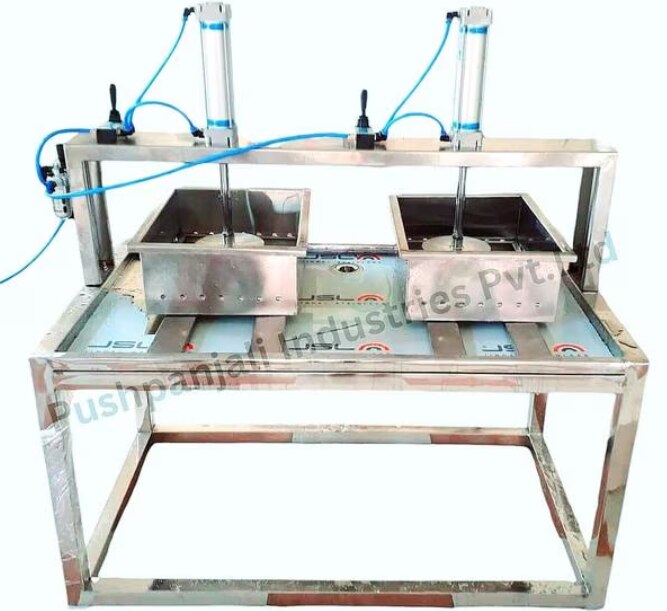
| Double-head pneumatic | Two mould sets increase output when filling and unloading keep pace | Similar control across both heads if the regulator and cylinders match | Higher machine and air demand; justified when daily batches support it |
| Hydraulic | High force for dense or large mould loads; powered operation reduces manual effort | Stable force, but pressure and dwell controls must be set correctly | Needs motor, pump, oil and leak checks; higher maintenance risk but no compressor |
Pneumatic pressing usually gives the best balance when you need consistent paneer or tofu without the oil-system maintenance of hydraulics. A single-head machine limits output but keeps the compressor, controls and spare-parts bill smaller; a double-head model earns its cost only when your mould loading and packing teams can sustain the extra capacity.
For intermittent production, manual pressing can remain cheaper overall. For continuous high-volume work, compare hydraulic electricity use with pneumatic compressor consumption, including air-line installation and receiver capacity.
How can you evaluate a pneumatic paneer press supplier in Ambala?
A quoted price is useful only after you make every supplier price the same scope. Ask each paneer press supplier in ambala for an itemised offer covering moulds, cylinder bore and stroke, controls, FRL unit, compressor, trolley, freight, GST, installation, commissioning, training, spare seals and warranty response.
Include site air-line work and unloading in the delivered-cost comparison.
| Offer | What to verify | Cost risk |
|---|---|---|
| Machine only | Frame, platen, cylinder and drainage | You add compressor, controls and tooling |
| Compressor-inclusive | Compressor horsepower, receiver size and continuous-duty capacity | A small receiver may cause pressure recovery delays |
| Automatic or double-head | Loading method, mould count and cycle control | Higher price is wasteful if labour or output does not justify it |
Before ordering a pneumatic paneer press in Ambala, require:
- A witnessed trial using your coagulated milk curd or tofu gel, not an unspecified catalogue product. Record batch weight, mould-fill weight, pressure, dwell time, cake thickness, moisture or yield, cycle time, leakage and cleaning time.
- Drawings, electrical and pneumatic schematics, operating instructions, warranty terms, spare-seal part numbers and a commissioning scope. Ask whether the quoted compressor supports continuous operation.
- A guarded pressing zone, two-hand or equivalent anti-trap control, emergency stop, controlled exhaust, pressure relief and a device preventing platen drop after air loss. Check alignment and drainage during the trial; ISO 4414 is the named reference for pneumatic-system safety.
- Compare Pushpanjali Industries with other Ambala quotations using the same recorded results, tooling dimensions and delivered-cost assumptions rather than the word “pneumatic” alone.
Related products
 | Pneumatic Paneer Press with Air Compressor ₹35000 Pneumatic Paneer Press Machine connected to a 50-liter portable air compressor. View product → |
 | ₹25000 Pneumatic Paneer and Tofu Press Machine, an essential piece of equipment for commercial dairy and plant-based milk production. View product → |
Frequently asked questions
What does a pneumatic paneer press price include?
A quotation can cover only the stainless-steel frame and pneumatic cylinder, or include moulds, trolley, FRL unit, valves, control panel, receiver tank, compressor and delivery. Request an itemised quotation before comparing prices.
Which specifications determine pneumatic press capacity and performance?
Compare mould dimensions, number of moulds, pressing force, cylinder stroke, batch capacity, cycle time, air consumption, operating pressure, stainless-steel grade and control features.
Can one pneumatic press be used for paneer and tofu?
Use interchangeable food-grade moulds and confirm that the stroke, pressing force and drainage arrangement suit both products. Set pressure and pressing time according to the product recipe rather than using one setting for every batch.
How does a pneumatic paneer press compare with manual and hydraulic pressing?
Manual presses cost less and suit small batches but require more labour and produce less consistent pressure. Pneumatic presses improve repeatability and cycle time. Hydraulic presses deliver high force but need hydraulic components, leak control and more maintenance.
How should you evaluate a pneumatic paneer press supplier in Ambala?
Ask for an itemised quotation, machine dimensions, food-contact material details, air requirements, demonstration or trial results, warranty terms, spare-parts availability, installation support and customer references.
Related product
 | Double Head Pneumatic Paneer Press with Air Compressor Double Head Pneumatic Paneer and Tofu Press Machine. It is a commercial-grade system designed for dairy and plant-based milk processing. View product → |
Keywords